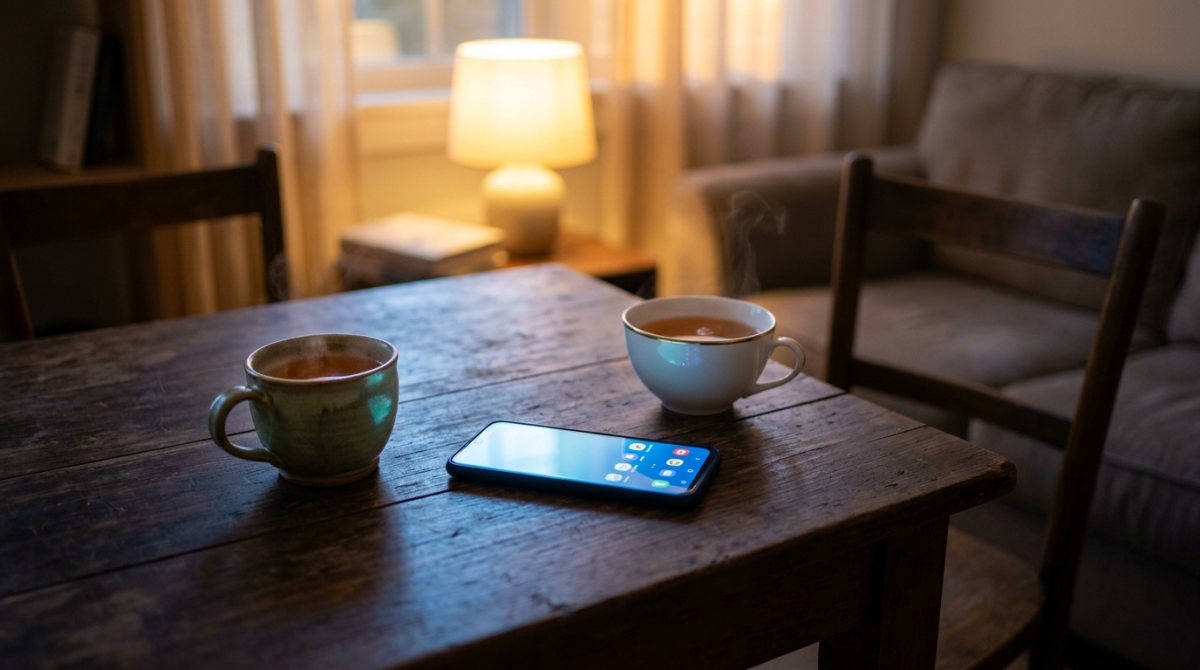
When Screens Come Between You: Protecting Attention in Marriage
A phone in the hand can quietly become a third presence in the marriage, pulling attention away a few seconds at a time. Protecting your attention for each other is one of the new challenges of married life.
A generation ago, the threats to a couple’s attention were obvious: long work hours, demanding relatives, too many obligations. Today there is a quieter one that sits in the palm of the hand. A phone does not announce itself as a rival, yet it pulls a spouse’s attention away a few seconds at a time, dozens of times a day, until two people can share a room and a sofa while being barely present to each other at all.
This is not a call to throw away devices, which are part of modern life. It is a call to notice what they quietly cost a marriage, and to protect the attention that two people owe each other. Attention is one of the deepest forms of love, and in a distracted age it has to be guarded on purpose.
The New Third Presence in the Home
When one spouse is constantly glancing at a screen, it is as if a third presence has entered the marriage, always competing for focus. The other person ends up sharing their partner not with a person, but with an endless stream of notifications, messages, and feeds that never stop arriving.
Naming this honestly helps. The issue is not that your spouse looks at a phone, but that the device has quietly claimed attention that used to belong to the two of you, and no one decided to let it.
Snubbing Your Spouse for a Screen
There is a small, common act that wounds more than people realize: turning to your phone in the middle of a conversation with your spouse. It sends a silent message that whatever is on the screen matters more than the person in front of you, even when that is not what you feel at all.
Done once, it is nothing. Done as a habit, it teaches your spouse that they are an interruption to your screen rather than the priority in the room. Over time, people stop bothering to share with someone who keeps half-looking away.
What a Screen Says When You Reach for It
Every time you reach for the phone in your spouse’s presence, you are making a small statement about priority. You may not mean it, but the message lands. A spouse mid-sentence, watching you scroll, quietly learns where they rank in that moment.
The reverse is also powerful. Choosing to put the phone down and turn fully toward your spouse, especially when something just buzzed, says something words cannot: right now, you matter more than whatever this is. That small choice, repeated, builds a deep sense of being valued.
The Illusion of Being Together
Couples today often spend evenings side by side, each absorbed in a separate screen, and call it time together. Physically they are close; in every other way they are in different worlds. This parallel solitude can feel companionable, but it slowly starves the marriage of real connection.
Being in the same room is not the same as being together. A marriage needs moments of genuine shared attention, not just shared furniture, and those moments rarely happen while both people are lost in their devices.
Protecting the First and Last Moments of the Day
For many people, the phone is the first thing they touch in the morning and the last thing at night, which means their spouse is greeted by the back of a screen at both ends of the day. These bookend moments are precious, and surrendering them to a device sets a cold tone.
A simple, powerful habit is to keep the first and last few minutes of the day screen-free, reserved for each other: a real greeting in the morning, a few words or a moment of closeness before sleep. Reclaiming these small windows can quietly warm a whole marriage.
Phone-Free Zones and Times
Some couples find it helps to agree on certain times or places that are simply screen-free: the dinner table, the bedroom, the first part of the evening. These are not punishments but protected spaces where attention belongs to the relationship and nothing competes for it.
The key is that this is agreed together, not imposed by one as a rule for the other. When both choose to set the devices aside at certain moments, those moments become small islands of real presence in a busy, connected life.
The Conversation That Never Happens
Much of the quiet drifting in modern marriages happens because the conversations that used to fill the gaps are now filled by screens instead. The few idle minutes where a couple once chatted, in the car, before sleep, while waiting, are now spent scrolling, and the small talk that wove two lives together slowly disappears.
Those small, unremarkable conversations matter more than they seem. They are how couples stay current with each other’s inner lives. When screens absorb every spare moment, the marriage loses the ordinary talk that quietly keeps it close.
When One Spouse Feels Alone Beside You
One of the loneliest feelings in marriage is to be in the same room as your spouse and still feel utterly alone, because their attention is entirely elsewhere. A person can feel like a stranger in their own home when their partner is always somewhere on a screen.
If your spouse has expressed this, it deserves to be taken seriously rather than dismissed as overreacting. Feeling consistently second to a device is a real and painful form of neglect, even when no harm was intended.
Comparison and the Curated Lives Online
Screens do not only steal attention; they also import comparison into the home. Scrolling through the polished, curated lives of others can make a person quietly dissatisfied with their own marriage, measuring a real, ordinary relationship against carefully edited highlights that are not the full truth.
Guarding against this is part of protecting the marriage. What you see online is a performance, not a life. A couple who remembers this is far less likely to let a screen plant seeds of discontent about a marriage that is, in reality, perfectly good.
Being Present as a Form of Respect
To give someone your full, undivided attention is to honor them. Islam places great weight on good treatment within the home and on giving people their due, and few things express respect today as clearly as setting the phone aside to truly attend to your spouse.
Seen this way, presence is not a small courtesy but part of how you live out kindness to the person closest to you. Many scholars remind us that good character shows most in the home, and in our time, undistracted attention is a real and meaningful part of that character.
Modeling Presence for the Children
Children are watching how their parents treat each other and their devices. A home where everyone stares at separate screens teaches children that this is what family life looks like. A home where parents put devices aside to talk and listen teaches them something far healthier.
By protecting attention in your marriage, you are also giving your children a model of real presence. They learn, without a word, that people matter more than screens, which is a lesson they will carry into their own future homes.
Small Agreements That Help
You do not need a dramatic digital detox to protect your marriage’s attention. Small agreements work well: no phones at meals, a basket where devices rest during family time, a habit of finishing a conversation before answering a message. Tiny rules, kept consistently, can reclaim a surprising amount of connection.
What matters is choosing these together and treating them with good humor rather than as a source of policing. The goal is not strictness but presence, and a light, shared commitment usually achieves far more than rigid rules ever could.
Choosing Each Other Over the Screen
In the end, this comes down to a thousand small choices: to look up when your spouse speaks, to leave the phone in another room sometimes, to let a notification wait while you finish a moment together. None of these choices is dramatic, and no one will praise you for them. But added across the years, they decide whether your marriage feels truly seen or quietly neglected. The screen will always be there, patient and endless. Your spouse’s need to feel like the most important presence in the room will not wait forever. Choosing them, again and again, over the glowing rectangle in your hand is one of the simplest and most loving things you can do in a distracted age.