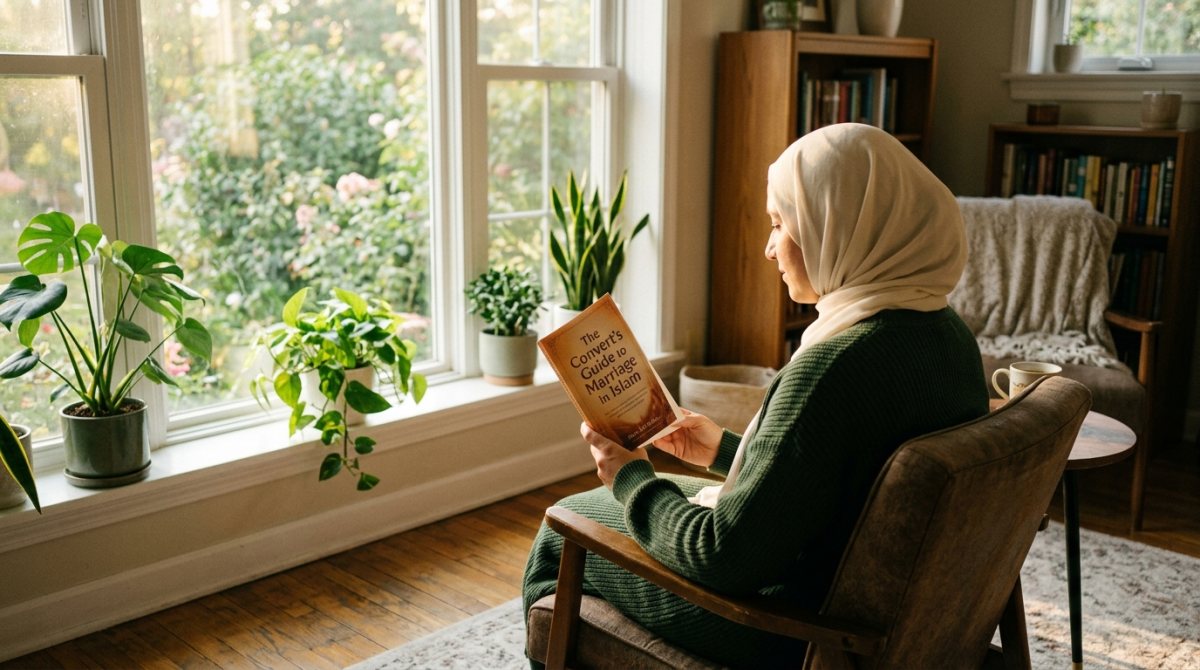
New to Islam and Ready for Marriage: A Guide for Converts
Converts bring sincerity to the search for marriage — and face questions others never meet: who is my wali, how do I tell culture from religion, and who can I trust? A practical guide.
Embracing Islam rearranges a life. Prayers enter the day, old habits leave it, and sooner or later a natural desire surfaces: to build a Muslim home, with a spouse who shares the faith you chose with your eyes open. For many converts, that desire arrives quickly — and so do questions that born Muslims never have to ask. Who acts as my wali if my family is not Muslim? How do I know whether an expectation is Islam or just someone's culture? And how do I protect myself from people who see a new Muslim as an easy opportunity?
This guide addresses those questions honestly. You chose this deen deliberately; your search for marriage deserves the same deliberateness.
First: let your Islam settle before your nikah
Marriage can feel like the missing piece of a new Muslim identity — the fastest way to belong, to have Ramadan at a family table instead of alone. That longing is legitimate. It is also the source of the most common convert mistake: marrying in the first months, before your own practice and understanding have found their feet, to a person chosen mostly because they were there.
You do not need to postpone marriage for years; Islam encourages it and community life is easier within it. But give yourself enough time to know what you believe, how you practise, and what kind of Muslim home you actually want. A spouse should join your journey, not define it for you. If your knowledge of the deen still comes mostly from one person — and that person is your suitor — pause and widen your sources first.
The wali question, answered calmly
For a convert sister, the first practical puzzle is guardianship. In Islam, a woman's wali in marriage is normally her Muslim father or male relatives — and a non-Muslim parent, however loving, does not hold that specific religious role. Scholars across the schools address her situation directly: a Muslim woman without a Muslim relative turns to the Muslim authority in her context, which today usually means the imam or a qualified, trusted figure at her local mosque or Islamic centre, who takes responsibility for representing her interests.
Practical steps that experienced communities recommend:
- Approach an established mosque or Islamic centre — not an individual who volunteers himself — and ask formally about wali arrangements for converts.
- Choose someone who will actually do the job: meet the suitor, ask hard questions, check references, and be willing to say no. A signature at the nikah is not guardianship; advocacy is.
- Keep your non-Muslim family informed and involved wherever they are willing. The wali fills a religious role; it does not replace your parents' love or their insight into your wellbeing.
Our article on the wali in marriage clears up broader misconceptions about what this role is and is not.
For convert brothers: patience with cautious families
A convert brother meets a different obstacle: the hesitancy of some families. You may sit before parents who wonder — sometimes aloud — whether your Islam is solid, whether you understand what raising Muslim children requires, whether their daughter will spend holidays defending her marriage to two sets of relatives.
Do not take the caution as an insult; take it as a question you can answer. Time answers it best: consistent practice, involvement in the community whose witness carries weight, learning that shows, and patience without grovelling. Many families who hesitated at the first meeting became the convert son-in-law's fiercest defenders within a few years. And a family whose objection is purely ethnic — nationality over deen — has told you something important about compatibility too.
Learn to separate religion from culture
Converts inherit the deen without the cultural packaging — which is a strength, but only once you can tell the two apart. In the search for marriage the confusion appears everywhere: wedding customs presented as religious obligations, dowry expectations inflated by regional habit, assumptions about roles and living arrangements that belong to a village somewhere, not to the Qur'an and Sunnah.
You are not obliged to adopt anyone's culture wholesale. You are obliged — and entitled — to the Islamic core: the conditions of a valid nikah, a mahr agreed with fairness (see our guide to setting the mahr wisely), mutual rights and kind treatment. When a demand confuses you, ask a knowledgeable, neutral source: "Is this from the religion, or from custom?" The answer will save you money, arguments and years of quiet resentment.
Protect yourself from wrong intentions
It is uncomfortable to write and necessary to read: some people specifically seek out converts — assuming they are naive about cultural warning signs, disconnected from protective networks, or useful for residency papers. Sincerity is your beauty; do not let it become your blind spot.
- Involve your community early. A suitor who resists ever meeting your imam, your wali or your Muslim friends is failing the most basic test.
- Check the person's standing with people who know them — their local mosque, their family, their long-term friends. References are normal in Muslim marriage culture; asking for them is not rude, it is the tradition.
- Be alert to urgency. Pressure to marry within weeks, especially combined with requests for money or immigration-related timing, is a pattern with a well-known ending.
- Verify religiosity by behaviour over time, not vocabulary. Anyone can learn the words mashallah and inshallah; consistency in prayer, honesty and conduct cannot be faked for long.
Compatibility questions converts should add
Alongside the standard questions every couple should discuss, your situation adds a few of its own. Raise them explicitly:
- How will we relate to my non-Muslim parents and siblings — visits, holidays, their role with our children?
- Does your family accept marriage to a convert wholeheartedly, or will I spend this marriage being quietly measured against someone from "back home"?
- What are your expectations of culture in our house — language, food, customs — and where do we agree the deen ends and preference begins?
- How will we keep learning together, given that we started from different points?
The general framework for these conversations is in religious and moral compatibility — the foundation neither of you can skip.
Your community is your extended family
The convert's disadvantage — no built-in Muslim family network — has a built-in remedy: the community itself. The Muslims who embraced you at your shahada can vouch for you, advise you, sit beside you at meetings with families, and celebrate at your walima. Invest in those relationships before you need them. If you live somewhere with few Muslims around you, the search widens naturally online, where scattered believers find each other — a reality we explore in halal marriage in Europe.
You are not marrying to complete your Islam
One final reassurance. Your Islam is already complete the moment you testified to it; marriage adds comfort, companionship and half of religious life's practical beauty — but you enter it as a whole person, not half of one. Search from that fullness, unhurried and clear-eyed.
Give yourself credit for the strength you bring
Amid all the cautions, do not lose sight of what a convert brings to a marriage that many born Muslims are still working toward: a faith chosen consciously, tested against a whole previous life, and held on purpose rather than by inheritance. You know why you believe what you believe. You have already made a difficult, principled decision and lived with its cost. That kind of conviction is exactly the foundation a serious marriage is built on, and the right spouse will recognise it as a rare gift rather than an unknown quantity. Search from that strength, not from a sense of having to prove yourself worthy of the community you joined.
When you are ready, ZawajAmine welcomes converts with the same seriousness as every Muslim: honest profiles, protected privacy, and space for your wali and community in the process. May Allah bless your path — the one that led you here, and the one ahead.