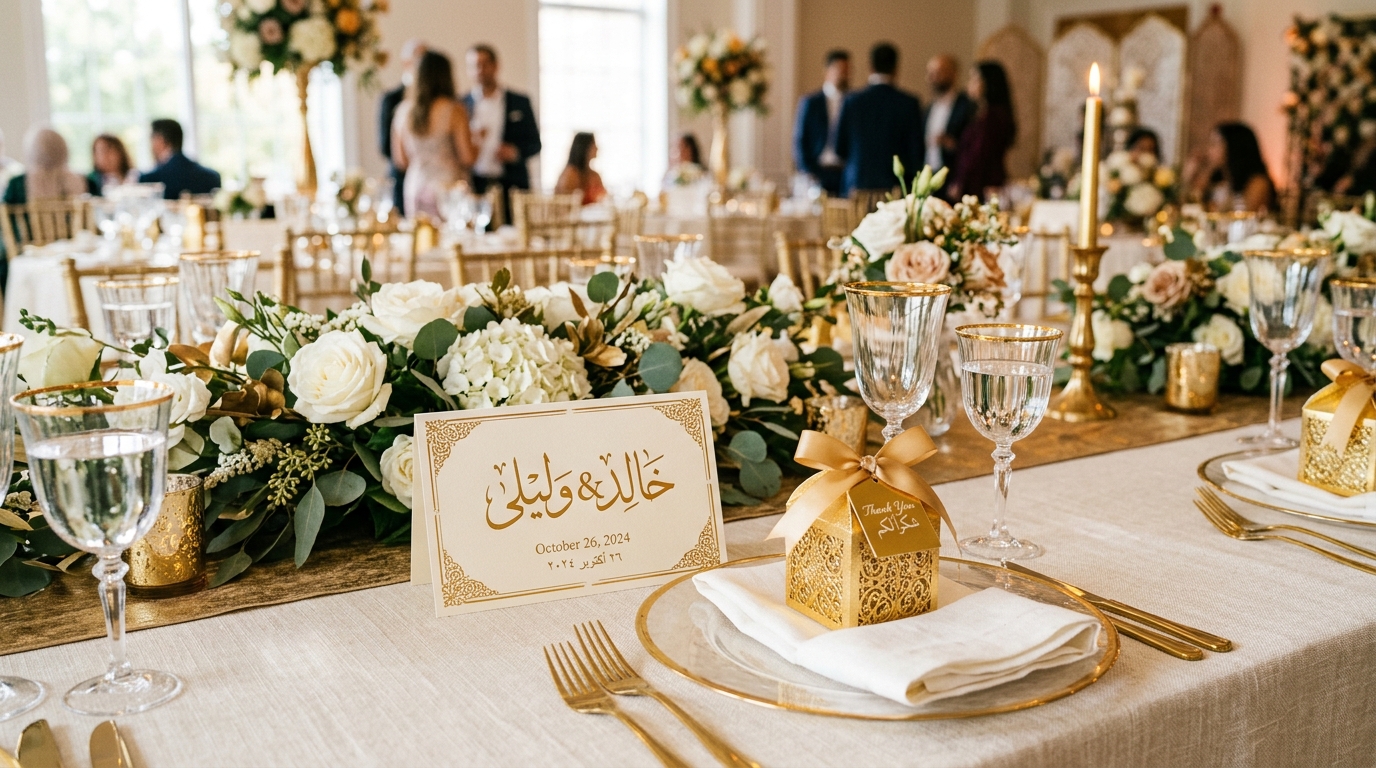
A table set with sweets and coffee cups for a family visit.
Whose Family This Eid? The Quiet War of the Holidays
The argument was never really about Eid. It was about a woman who had spent nine years watching her own mother eat the first morning of every Eid alone.
The argument started on the twenty-sixth of Ramadan, in a car, over something that was not the subject. By the time they reached the house neither of them was speaking, and Maryam had said the sentence she had been holding for nine years: that his mother had never once had to eat the first morning of Eid without her son, and that her own mother had never once had a first morning with her daughter.
Hassan was genuinely astonished. In nine years he had never thought about it as a pattern. Every Eid, they went to his family first because that was what happened; it had never been decided, and because it had never been decided he had never noticed that it always went one way.
That is the shape of this argument in most marriages. It looks like a fight about a day. It is almost never about the day.
Why the holidays hurt more than ordinary weeks
Any ordinary Tuesday, an unfair arrangement can be tolerated because there will be another Tuesday. Eid is different: it comes twice a year, it is finite, and everybody's parents are getting older. A mother who does not see her daughter on the morning of Eid has lost that morning permanently, and both the daughter and the mother know it.
The weight is heaviest on whoever moved. A wife who left her city, or her country, has lost the ordinary daily presence of her family and now measures her relationship with them in occasions. When those occasions also go to the other side, what she loses is not a lunch; it is the last reliable point of contact she had.
And there is the audience. Nobody notices who cooked on a Tuesday, but everyone notices who was absent at Eid. A grandmother's neighbours ask why her son did not come. A brother mentions it. The occasion is public, so the absence is public too, which is why families invest it with a meaning far beyond the food.
What the two of you are actually arguing about
Underneath almost every holiday argument is one of three things, and it helps enormously to know which.
Sometimes it is fairness: one side has been visited nine times and the other twice, and the person keeping count is not petty, they are tired of a pattern nobody will name. Sometimes it is guilt: a woman who watches her mother alone on Eid carries a weight that has nothing to do with her husband, and it comes out at him because he is the one in the room. And sometimes it is respect — a spouse who feels their family is treated as the lesser one, invited late, visited briefly, mentioned less.
Working out which of the three is in play changes the conversation completely. Fairness is solved with a calendar. Guilt is solved by arranging something for the mother rather than by punishing the husband. Disrespect is solved only by the spouse whose family is doing it, and by them saying something to their own relatives.
Deciding it once, instead of every year
The households that stop having this argument all do the same thing: they make a rule in advance, when nobody is angry, and then they stop renegotiating it in the week before Eid.
The rule most families arrive at is alternation. One Eid with his family, the next with hers, and if the two Eids in a year are split one each, then it rotates the following year so that neither side permanently owns the bigger occasion. Where families live in different countries, the alternation happens across years rather than months, and the couple say so plainly to both sides so nobody is guessing.
Others split the day rather than the year: the morning prayer and breakfast with one family, the evening meal with the other. This works well when both families are in the same city and badly when they are not, because a couple who spend Eid driving are not present anywhere.
Whatever the arrangement, two details make it survive. It has to be written somewhere both of you can see — a note in a shared calendar is enough — because memory is partisan. And it has to be announced to the relatives early, in a friendly way, by the spouse whose family it is. A husband tells his mother in advance that this year they are with Maryam's family; that single call prevents the version where his wife is blamed for a decision they made together.
What the religion asks, and what it does not
Kindness to parents is one of the highest obligations in Islam, and it is not cancelled by marriage. A man owes his mother care and companionship, and a woman owes hers the same. Nothing here suggests that a wife should cut off her family, or that a husband should neglect his.
What is often assumed but not actually required is that the husband's family automatically comes first on every occasion. A wife's parents have rights over her too, and maintaining ties with relatives — silat al-rahim — is spoken of with great seriousness. A household that systematically prevents a woman from seeing her own parents is not upholding a religious principle; it is upholding a custom, and one that causes real harm to the family that raised her.
The balance most scholars and most sensible grandmothers arrive at is the obvious one: both sides are visited, neither is abandoned, and the arrangement is made with consultation rather than by whoever shouts loudest.
When one family makes it impossible
Sometimes the difficulty is not between husband and wife at all. One set of parents refuses to accept any arrangement, treats every alternate year as an insult, and applies pressure through phone calls and hurt silences.
Here the rule is the same as everywhere else in marriage: each spouse handles their own family. If his mother is the one applying pressure, it is his job to absorb it, and to keep absorbing it, rather than passing it to his wife in the form of "can we just go this year to keep the peace." Peace bought that way is always paid for by the same person.
And if a marriage has genuinely been unable to visit one side for years — because of money, or distance, or immigration — say that honestly to the family instead of letting them believe they are unloved. Most parents can bear a hard truth. What they cannot bear is silence that looks like indifference.
Maryam and Hassan
They fixed it in about twenty minutes, three days after the argument, which is usually how long it takes once the real subject is on the table.
They alternate now. He calls his mother in advance when it is not her year, and takes her something the day before. Maryam's mother is in another country, so on the years that are hers they call at six in the morning, before either family's house fills up, and Maryam's mother eats her breakfast with her daughter on a screen propped against a bowl. It is not the same as being there. It is enormously better than the nine years before it.
What Hassan says now is the part worth keeping: he had not been choosing his mother over hers. He had simply never noticed that not choosing is also a choice, and that it had been quietly making the same decision every year for nearly a decade.
The same negotiation runs through Ramadan and every other shared season — your first Ramadan as a couple and dealing with in-laws cover the rest of the year.
Questions couples ask
Whose family should a couple spend Eid with?
There is no religious ruling that gives one side priority. It is a decision two adults make together, and the arrangements that last are the ones agreed once — alternating years, split days, or a fixed pattern — rather than renegotiated in tears every year.
Is a wife obliged to spend Eid with her husband's family?
No. Kindness to both families is encouraged and neither set of parents has a claim that overrides the couple's own decision. A wife also has parents who miss her, and that is not a disloyalty to anyone.
How do we decide without an argument every year?
Decide the pattern once, in a calm month, and write it down. Almost all of the pain in this subject comes from deciding under pressure a week before, when everyone is already emotional and somebody's mother has already asked.
What if one family reacts badly?
Each spouse handles their own family, warmly and once. Announcing the pattern early, as a decision already made rather than a request for permission, removes most of the pressure before it starts.
What if we live far from both families?
Build your own morning first — prayer, food, whatever you want your children to remember — and then add the calls and visits. Couples who wait until they are "properly settled" to build traditions frequently never build any.